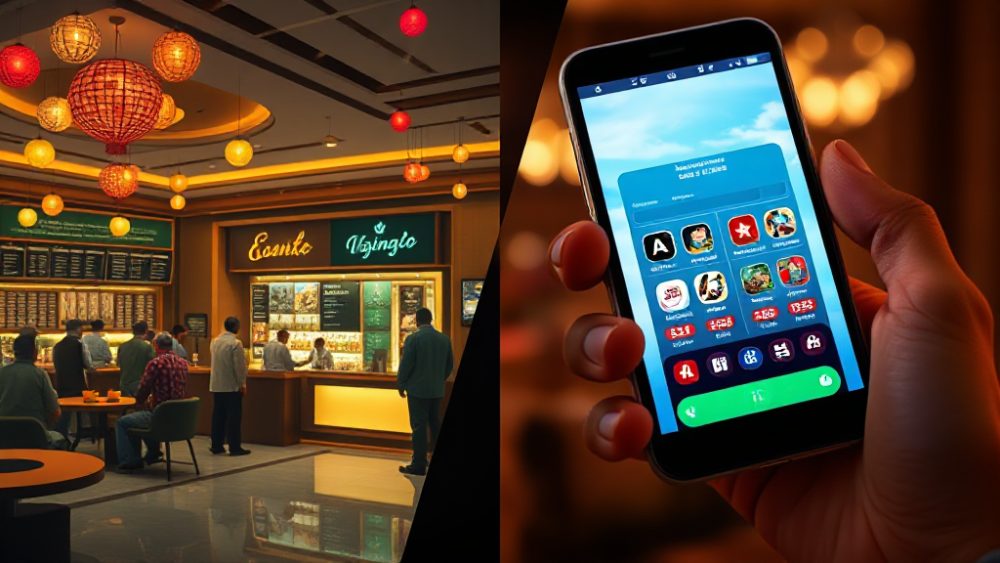
From Shopfront to Screen: tk999 in a Regional Shift
Imagine a narrow lane in a South Asian city some thirty years ago. A shutters-up betting shop, fluorescent tube flickering, men crowded shoulder to shoulder around a chalkboard of odds, the air thick with cigarette smoke and the scratch of pens on paper slips. The transaction was physical, the information was local, and the day ended when the shutters came down. Now imagine the same person today, standing at a bus stop, thumb moving across a phone screen, placing the same kind of wager without a shopfront in sight. That journey from counter to pocket is the story this essay follows, and tk999 is one useful example of how the shift has settled into everyday life in Bangladesh.
The Physical Betting Shop and Its Social World
The old betting shop was never just a place to place a wager. It was a social institution with its own hierarchy, its own rituals and its own forms of expertise. The bookmaker stood behind a counter or a grille, often with a ledger and a telephone, while the punters gathered in front of him, comparing notes, arguing about form, and passing around newspapers folded to the sports pages. Information moved slowly and unevenly, which meant that the person who knew something first held a real advantage.
This world had clear boundaries. The shop had opening hours, a physical address, and a face behind the counter. It also had a visible cost: travel, time, and the social exposure of being seen walking in. For many people, that exposure was part of the appeal, a marker of belonging to a particular kind of male sociability. For others, it was a deterrent. The shopfront therefore selected its own audience, and that selection shaped who could participate and how often.
Why the shopfront mattered
The shopfront performed three functions that are easy to overlook. It was a trust anchor, because a business with a lease and a sign has something to lose. It was a settlement venue, where cash changed hands and disputes could be argued face to face. And it was a social filter, because the visibility of the place kept some people out and drew others in. Any digital replacement has to solve those three problems in a different way, and much of the history of online betting is the history of solving them.
The physical era also had a particular rhythm. Big events concentrated the crowds, ordinary days were quiet, and the shop’s calendar was set by the sporting calendar. The bookmaker’s margin came from the odds, but his reputation came from paying out promptly and without argument. In a small market, reputation was the real currency, and it travelled by word of mouth from one neighbourhood to the next.
The Move to the Phone and the New Geography of Play
The first great change was not the internet itself but the arrival of the smartphone as an ordinary possession. A device that fits in a pocket and stays connected all day removes the two constraints that defined the shopfront era: location and opening hours. The betting interface no longer lives on a high street; it lives in an app, available whenever the phone is in hand. For a country like Bangladesh, where mobile penetration has grown far faster than fixed-line infrastructure, this is not a marginal change. It is the main event.
The second change is informational. In the old shop, odds were posted once and argued over. On a screen, prices move continuously, and the punter can compare markets, follow live events, and see the same information as everyone else. That flattening of information asymmetry is genuinely new. It does not make anyone a better predictor, but it changes the texture of the experience from a periodic visit to a continuous presence.
From venue to interface
When the venue becomes an interface, the design of that interface starts to do the work that the shopfront used to do. Registration replaces the account opened at the counter. A downloadable app replaces the walk to the high street. Notifications replace the chalkboard. The old social filter disappears, which is liberating for some users and risky for others, because the friction that once slowed a decision has been deliberately removed.
This is why the regional shift is not simply a story of convenience. It is a story about friction as a form of protection. The shop closed at night; the app does not. The shop required a journey; the app requires a thumb. Every removed step is a gain in access and a loss in natural pause, and the balance between those two is the central question for anyone thinking seriously about this industry.
tk999 as an Illustrative Case of the Mobile Model
Seen against that background, tk999 is a recognisable type rather than an exception. It is an online betting platform aimed at Bangladeshi users, built around two familiar pillars: a registration process that creates an account, and a downloadable app that puts the interface on the phone. The brand presents itself as a trusted online betting platform, which is exactly the claim the old shopfront used to make through its lease, its sign and its willingness to pay out in public.
What is interesting is how the model compresses the old geography. There is no high street, no counter, no closing time in the traditional sense. The user encounters the platform first as a screen, then as a routine, and the trust that the shopfront earned through physical presence has to be earned instead through consistency, clarity and the reliability of the app itself. That is a different kind of trust, and it is harder to inspect from the outside.
What the case shows about the shift
The case illustrates three features that are common across the region. First, mobile-first design is not an add-on but the primary channel. Second, registration is the moment where the platform and the user formally meet, replacing the conversation at the counter. Third, the app is the product in a practical sense, because a betting interface that is slow, confusing or unstable loses the user before any wager is placed. The old bookmaker’s reputation lived in his ledger; the new one lives in the quality of the software.
It also shows how the regional market differs from older Western models. In markets where desktop computing arrived first, the online betting industry grew out of a web experience and later moved to mobile. In Bangladesh and much of South Asia, the order is reversed: for many users the phone is the first and only computer, so the mobile experience is the whole experience. That single fact reshapes everything from payment methods to how much screen space a market can occupy.
Trust, Regulation and the Unfinished Work of Legitimacy
Every gambling market, physical or digital, rests on a bargain between the operator, the user and the state. In the shopfront era the bargain was local and visible: licences on the wall, inspectors at the door, a known face behind the counter. In the digital era the bargain is distributed and often opaque. The user cannot see the licence, cannot inspect the ledger, and cannot argue with a person. Trust has to be manufactured through disclosure, through consistent behaviour, and through the slow accumulation of a track record.
This is the hardest part of the regional shift, and it is where the essayist has to be careful. The technology has moved faster than the institutions that used to supervise it. Mobile payment rails, app distribution and cross-border operation have all made the industry easier to run and harder to police. For users, the practical consequence is that due diligence moves to the individual. Checking who operates a platform, how withdrawals are handled and what the terms actually say is now part of the user’s job in a way it never was at the counter.
The three trust problems of the screen
The first is identity: who is behind the platform, and is there a real business with real accountability? The second is settlement: will the money move when it is supposed to, and how quickly? The third is conduct: how does the platform behave when something goes wrong, and is there a route to complain? The shopfront answered all three through physical presence. The screen has to answer them through evidence, and users who learn to look for that evidence are better protected than those who do not.
Regulation, meanwhile, is catching up unevenly. Some jurisdictions have built licensing regimes for online operators; others have restricted or prohibited the activity; most are somewhere in between, with rules that were written for physical venues and are being stretched to cover apps. The result is a patchwork that users experience as inconsistency: the same platform may be legal in one market and not in another, and the rules may change while the app stays on the phone. Understanding that patchwork is part of understanding the industry as it actually exists.
What Changes and What Does Not
What changes, first, is access. The phone removes the journey, the opening hours and much of the social exposure, and it brings the interface into the ordinary moments of the day. What changes, second, is information: prices, markets and results are available continuously, and the punter is no longer dependent on a chalkboard or a newspaper. What changes, third, is the unit of trust, which moves from the person behind the counter to the software and the operator behind it.
What does not change is the underlying arithmetic. Every betting market carries a margin, and no interface, however well designed, alters the mathematics of the odds. What does not change either is the human tendency to overestimate skill and underestimate variance, which is the engine of the industry in every era. The shopfront did not create that tendency, and the app does not create it; both simply provide a place for it to operate. The difference is that the app is always available, which makes the tendency easier to act on and harder to interrupt.
What also does not change is the need for limits. In the physical era, limits were built into the environment: the shop closed, the money ran out, the journey home intervened. In the digital era, limits have to be built into behaviour and, increasingly, into the platform itself through tools that let users set their own boundaries. The regional shift has made those tools more important, not less, because the environment no longer supplies the pauses that the old geography supplied by default.
The most useful way to read the shift, then, is not as a rupture but as a relocation. The social world of the betting shop has not vanished; it has been redistributed into group chats, forums and the shared screens of a generation that never knew the chalkboard. The rituals remain, the arguments remain, and the arithmetic remains. What has gone is the shopfront, and with it a set of physical cues that once told people when to stop. Rebuilding those cues for the screen is the unfinished work of the next decade, and it will matter more than any single platform’s design.